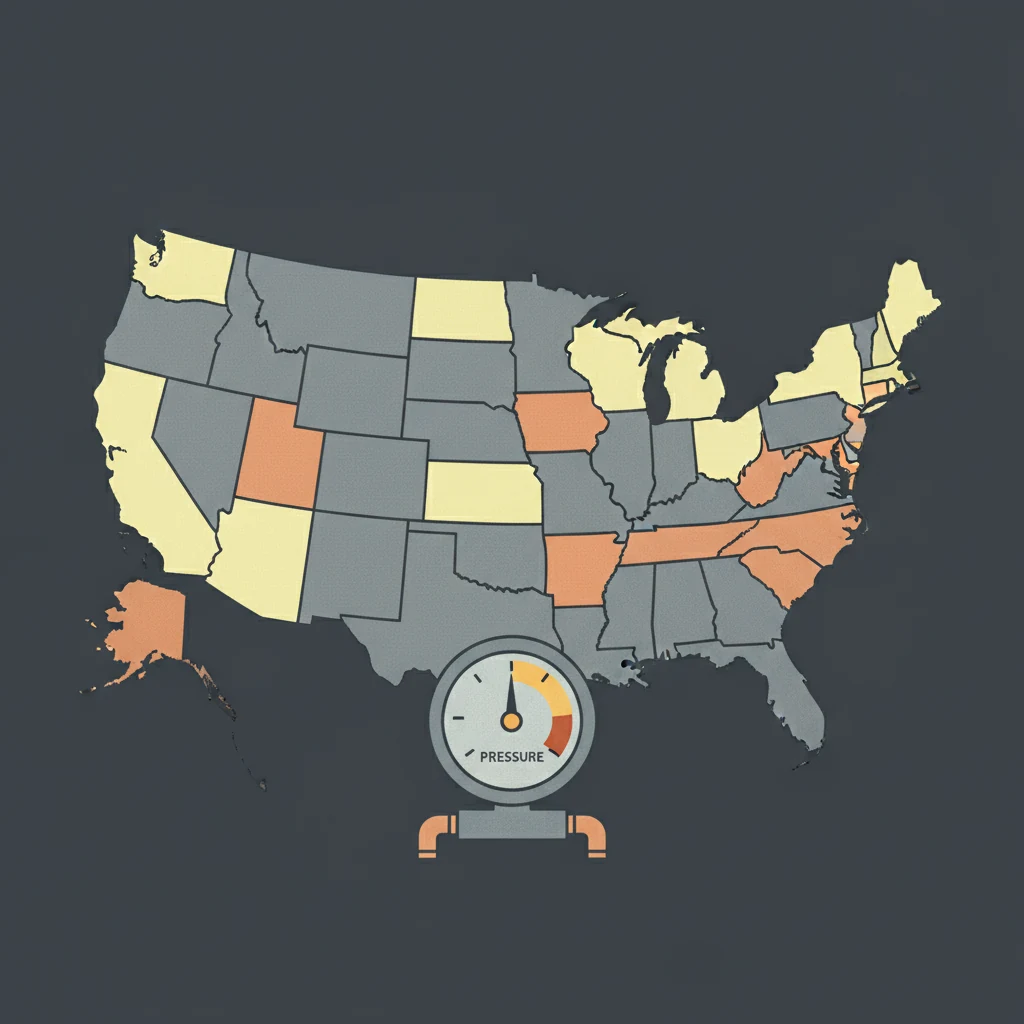
An HVAC tech leaves Tampa for a job in Houston. EPA 608 Universal in his wallet, eight years on residential and light-commercial systems, NATE-certified. He gets to Texas and finds out he can't pull a permit, can't run service on his own, and — depending on which side of the city line he's on — can't even legally bench-test a compressor without a state-licensed contractor backing the job. He's not unlicensed in the sense most people mean. He just isn't licensed in Texas. Nothing he carries from Florida transfers automatically.
This is the part of the trade most schools don't teach and most career articles miss. There isn't one HVAC license. There are two — a federal one that travels everywhere and a state one that, in most cases, doesn't travel at all. The reciprocity story is patchwork: a few state-pair agreements, a much larger set of "endorsement" pathways, and a handful of states where there's no statewide license to reciprocate at all because licensing happens at the city or county level. The mechanics of how all that fits together is what determines whether a moving tech keeps working or sits out a license cycle.
Two licenses, not one
The license most techs know about is the EPA 608 certification. It's federal, governed by the Clean Air Act, administered through approved exam providers (ESCO, Mainstream Engineering, RSES, others), and it covers exactly one thing: the legal authority to handle, recover, and dispose of regulated refrigerants. Every tech who touches a sealed system needs it. Type I, Type II, Type III, or Universal. It's a card; it doesn't expire; it follows you.
What the 608 does not authorize is performing HVAC work as a contractor or, in many states, even as an independent journeyman. That second authorization is a state-issued contractor license — and the structure varies enough that "I'm licensed" means different things in Atlanta, Sacramento, and Phoenix.
States generally fall into one of four patterns:
- Statewide contractor license, tiered. Florida, California, Texas, North Carolina, and most of the South use this model. There's a journeyman or apprentice tier, sometimes a "registered" or "certified" technician designation, and a contractor tier that lets the holder pull permits and run a business. Each tier requires a separate exam and experience verification. Florida's Class A and Class B Air Conditioning Contractor licenses issued by the Department of Business and Professional Regulation are a clean example: Class A covers any size system, Class B caps at 25 tons of cooling and 500,000 BTU heating.
- Statewide contractor license, single tier. Some states issue a single mechanical or HVAC contractor license without a separate journeyman tier. The state regulates the contractor; the contractor supervises the technicians. Whether a non-licensed tech can do unsupervised service work depends on the regulation's wording.
- No statewide license — local jurisdictions instead. A handful of states leave HVAC licensing to cities and counties. Pennsylvania is the most common example: there's no Pennsylvania HVAC license, but Philadelphia, Pittsburgh, and several counties run their own. Same in much of Ohio at the contractor tier.
- Statewide license, business-only (no individual technician license). A smaller group of states only license HVAC businesses, not individual techs. The business has a registered qualifying agent; the techs working under it don't carry a personal credential beyond EPA 608.
The same job — installing a 3-ton split system at a residence — can require five different combinations of paperwork depending on which of those four worlds the address sits in.
Why reciprocity is patchwork
Reciprocity exists when one state's licensing board agrees to recognize another state's license, usually with a documented agreement and an application process for the moving tech. It's the closest thing the trade has to portability — and it's narrower than most techs assume.
Three structural reasons:
State boards are independent. Each board is a state agency with its own statute, rulemaking authority, and exam provider. Reciprocity isn't a default — it's a deliberate agreement two boards have to sign. Both sides have to want it, which usually means both sides have similarly-rigorous testing. Boards are reluctant to recognize licenses from states with substantially weaker exams or experience requirements, which is most of the friction.
Tier mismatches break recognition. A Florida Class A contractor and a North Carolina H-3 Class I unrestricted contractor are roughly equivalent — but a Florida Class B and a North Carolina H-3 Class II are not, because the system-size caps differ. Boards don't reciprocate by trade; they reciprocate by tier-equivalent. Mismatched tiers force exam re-takes even between states with cooperative boards.
Local-license states have nothing to reciprocate. If you hold a Pittsburgh HVAC license, you can't reciprocate it into Florida — Pittsburgh isn't a state board, and Florida won't recognize a city credential. You're treated as unlicensed for state-license purposes.
Reciprocity exists, but it's not a national network. It's a series of bilateral handshakes between states whose boards have decided their tests are close enough.
What actually clears a tech to work in a new state
Three pathways. In rough order of speed:
1. Direct reciprocity / endorsement. A small number of state pairs maintain mutual recognition agreements that let a licensed contractor in State A apply for the equivalent license in State B without re-taking the trade exam — typically a paid application, a background check, and proof of license-in-good-standing. These agreements show up most often between neighboring Southern and Mid-Atlantic states (the Carolinas, Tennessee, Georgia, Alabama, and Mississippi have a tangle of bilateral agreements at various tiers; Florida maintains specific agreements that change periodically). The only authoritative source for any given state pair is the state's own licensing-board website — agreements get added, paused, and rewritten, and third-party "reciprocity matrix" pages tend to lag. When you see a list claiming "these 12 states reciprocate," verify each pair on the destination state's board page before relying on it.
2. License-by-examination with exam waiver. The more common pathway. A state without direct reciprocity may still waive part of the exam — typically the trade portion — for an applicant who already holds a current license in another state and meets the experience threshold. The applicant still sits the law/business portion (state-specific contracting law, lien rules, workers' comp obligations). This is faster than starting from scratch but slower than direct endorsement: it's an exam appointment, not a paperwork-only application.
3. License-by-experience. The slowest pathway, used when neither reciprocity nor exam waiver applies. The tech submits documented experience (W-2s, signed affidavits from prior supervisors, project lists), waits for board review, and sits the full trade exam if approved. Most moves into California from outside the Southwest end up here, because California's CSLB is selective about which out-of-state licenses it'll recognize for waiver purposes.
Two facts most techs miss:
- Experience verification often clears even when reciprocity doesn't. A tech who worked under a licensed contractor in a non-reciprocal state can usually count those years toward the destination state's experience threshold, as long as the supervisor will sign for it. This matters for techs who started in a Pennsylvania city license — that local credential won't reciprocate, but the documented years of work under a licensed contractor will count toward, say, Florida's four-year experience requirement for a Class B.
- EPA 608 is reciprocal because it's federal. No state needs to "recognize" your 608 — it's already valid everywhere. The only thing the state license layer adds is the contractor authority, not the refrigerant-handling authority.
The work-while-you-license window
What does a tech actually do for the months between landing in a new state and getting the license processed?
The honest answer is employed but supervised. Most state statutes allow a non-licensed tech to perform HVAC work as long as the work is being supervised by a licensed contractor — that's the ordinary employment relationship for most service techs in their own state. A moving tech who lines up a job with a licensed shop is, in most states, immediately legal to work the truck. They just can't pull permits, sign contracts, or run service calls as the licensed party of record.
The friction shows up for techs trying to move and stay independent at the same time — buying their own tools, running their own truck, and pulling their own permits. That's the path that requires the destination-state contractor license before the first job, and the path where reciprocity matters most.
The decision to move-then-license vs. license-then-move usually breaks on this question: do you want to keep working as an employee for the first six months, or do you want to land independent on day one? Most apprenticeship-trained techs are fine with the former; established small-business HVAC contractors usually plan a longer timeline because the license has to clear before the business can.
Practical playbook for moving states
What a tech should actually do, in order:
- Start with the destination state's licensing-board page. Search "[state] HVAC contractor license reciprocity" and go directly to the official state board (Florida DBPR, Texas TDLR, California CSLB, North Carolina State Board of Examiners of Plumbing Heating and Fire Sprinkler Contractors, etc.). Third-party "reciprocity by state" pages are useful for orientation but should never be the source of a licensing decision — the rules change, and the state board is the only authoritative version.
- Identify which tier you'd be applying for. Match your current license to the destination's tier structure. A Florida Class A is not a Texas Class B — work out the size-cap and scope-of-work equivalents before assuming your current credential maps anywhere.
- Check whether your current state has a documented agreement with the destination. If yes, the application is paperwork-only or paperwork-plus-law-exam. If no, plan for a full trade exam.
- Pull together your experience documentation early. Even when reciprocity exists, most state boards require proof of years-of-experience under a licensed contractor. Get the W-2s and supervisor affidavits before you move; they're harder to chase down after.
- Consider the apprenticeship route as a backstop. If reciprocity fails and the experience documentation is thin, joining a registered apprenticeship in the destination state is the most reliable path to a clean license without re-doing the full credentialing cycle. The DOL Office of Apprenticeship maintains state sponsor lists; TradeSchoolOutlook's HVAC apprenticeship sponsor pages aggregate the same data by state for browsing.
- Don't rely on EPA 608 alone. Holding the 608 makes you legal to handle refrigerant; it doesn't make you legal to perform HVAC work for compensation in most states. Treat the 608 and the state license as two separate, both-required credentials.
Bottom line
The HVAC trade is federalized at the refrigerant layer and balkanized everywhere else. EPA 608 travels; state contractor licensing usually doesn't. Reciprocity exists but is bilateral, narrow, and changes often enough that it's worth verifying directly with the destination state's board before any move. For a tech willing to work as an employee under a licensed contractor for the first license cycle, the friction is manageable. For an independent contractor trying to move a one-truck operation across state lines, the friction is significant — and underestimating it is the most common reason techs end up sitting out billable months.
The trade itself is one of the most durable skilled-trades careers in the federal data, and it's apprenticeable in every state through DOL-registered programs. The licensing layer is the part that requires homework. Do the homework on the destination state's board pages — not on third-party reciprocity charts — and the move usually works. Skip the homework and the new state will discover, on your behalf, exactly which credentials you don't have.