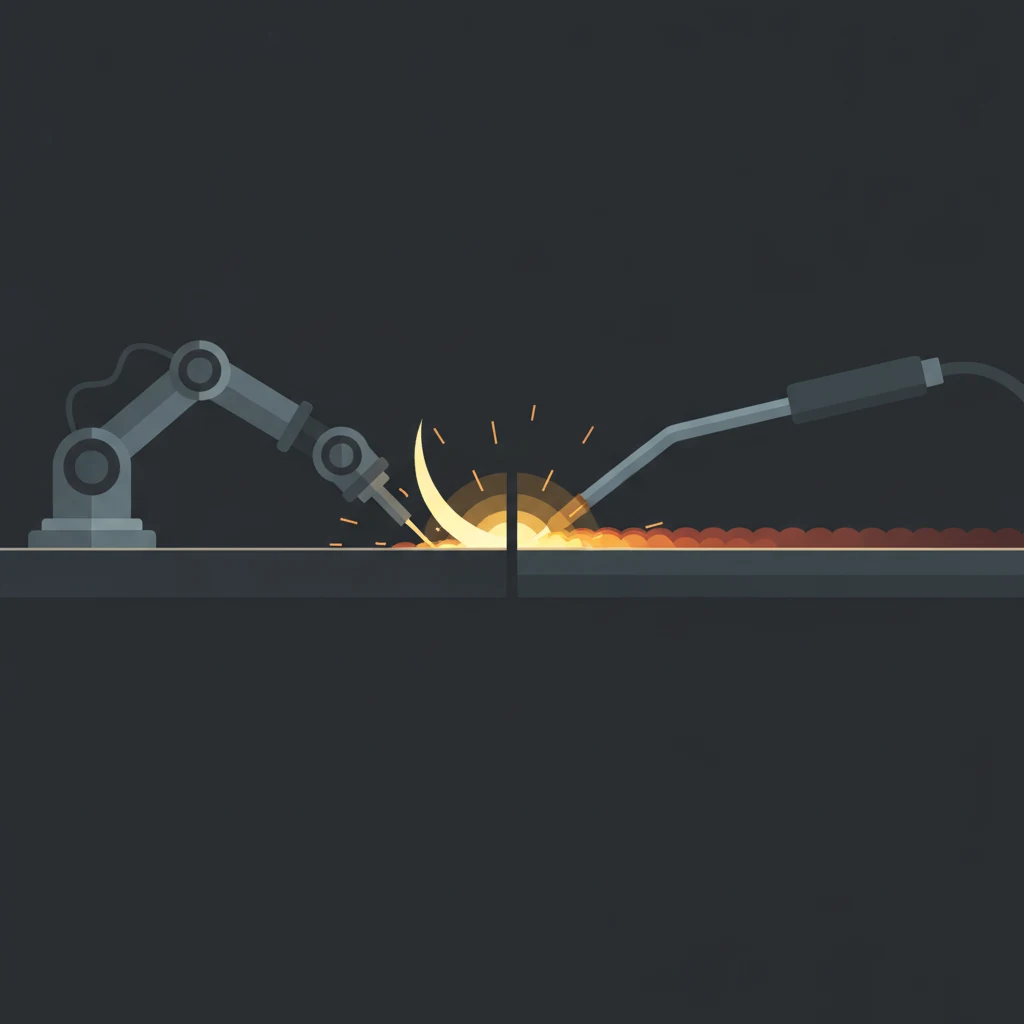
Two numbers get quoted whenever someone asks whether welding is a good career, and they seem to contradict each other. The American Welding Society says the country needs roughly 320,000 new welding professionals by 2029 — a figure that gets rounded up into headlines about a desperate, six-figure-paycheck shortage. The U.S. Bureau of Labor Statistics, using its own occupational data, projects welding employment will grow just 2% through 2034 — slower than the average job — with a median wage of $51,000. One number sounds like a gold rush; the other sounds like a dead end.
They're both accurate. They just measure different things, and neither one answers the question you're actually asking. Welding is a solid trade in 2026 — but the honest case for it looks nothing like the shortage headline, and the automation panic gets the risk backwards. The decision that matters isn't whether to weld. It's which welding, and how you get in.
Start with the number that isn't trying to sell you anything
The cleanest baseline is the BLS occupational data for Welders, Cutters, Solderers, and Brazers (occupation code 51-4121), because BLS has no enrollment to fill and no certifications to sell. Here's what it actually says for 2026:
| Metric | Figure (latest BLS) |
|---|---|
| Median annual wage (May 2024) | $51,000 |
| Lowest 10% earn less than | $38,130 |
| Highest 10% earn more than | $75,850 |
| Projected employment growth (2024–2034) | +2% (slower than average) |
| Average annual openings (2024–2034) | 45,600 |
Read those two bottom rows together, because that's where the confusion starts. Employment barely grows, yet the field opens 45,600 jobs every year. That isn't a contradiction — it's the single most important fact about welding as a career, and we'll come back to it. First, the shortage number. BLS Occupational Outlook Handbook — Welders, Cutters, Solderers, and Brazers
Where the "320,000 shortage" number really comes from
The 320,000 figure is real, but it's worth knowing who's counting and what they're counting. It comes from the American Welding Society — the industry's trade group, whose members include the schools and certification bodies that benefit when more people enroll. That doesn't make the number fake. It makes it broad and directional rather than a headcount of hands-on welding jobs.
AWS counts the entire welding ecosystem: not just people striking an arc, but inspectors, welding engineers, robotic-cell operators, educators, and supervisors. BLS occupation 51-4121 counts only the person doing the welding. So when AWS says "320,000 welding professionals" and BLS says "45,600 hands-on openings a year," they aren't disagreeing — they're drawing different boxes around the word "welding." If you're deciding whether to learn to weld, the narrower BLS box is the one that describes your actual job market.
And notice what the shortage number is not driven by: booming demand for brand-new positions. Both AWS and BLS agree the need is overwhelmingly about replacing people who leave, not adding roles that never existed.
The replacement engine: why 45,600 jobs open in a field that barely grows
Here's the resolution to that puzzling pair of numbers. Net employment grows only 2%, but 45,600 seats open annually because welding has a demographics problem and a body problem at the same time.
- The retirement wave. The average U.S. welder is about 55 years old. Roughly 21% of the workforce is over 55, while fewer than 10% are under 25. A large share of today's welders will retire this decade, and there is no equally large cohort behind them.
- Mid-career attrition. Welding is physically hard on the people who do it — fumes, joint wear, and eye strain are real occupational costs. Plenty of welders leave the torch well before 55, moving into inspection, supervision, sales, or entirely different work. Those exits open seats too.
So the opportunity in welding is genuine, but it's an opportunity to fill chairs being vacated, not to ride an expanding industry. That distinction changes how you should read every "welders in demand" article you see.
The wage test: what a real shortage would look like
If welding were the acute, desperate shortage the headlines describe, the wage data would show it — employers bidding pay up sharply to win scarce workers. Instead the median sits around $51,000 and has tracked, not outrun, the broader labor market. That tells you something specific: when welding labor gets tight, many employers would rather automate a station or turn down a job than pay dramatically more. A shortage that doesn't move wages is a shortage in particular places and skills — not a blanket seller's market. Before you bank on any "high-paying trade" claim, it's worth learning how to read a trade wage before you pick it, because the median is not the number you'll start at.
The automation question, answered honestly
Now the other headline: are robots taking welding jobs? The robotic-welding market is real and growing at roughly 10% a year. But "robots are coming for welding" and "welding is a dead trade" are two very different claims, and only the first is true.
Automation is capping welding's growth, not erasing the field. That flat +2% projection isn't a sign the work is disappearing — it's the fingerprint of automation. End-market demand for welded metal is strong (more on that below), yet employment stays flat because each welder, aided by automated cells, produces more than they used to. Robots absorb the growth that would otherwise become new hiring. They are not, on the current evidence, shrinking the absolute number of welding jobs — but they are quietly changing which jobs those are.
The split is fairly predictable, and it's the heart of the decision:
| Automation takes this | Humans still do this |
|---|---|
| High-volume, repetitive shop welds | Field welding on job sites |
| Identical parts on a production line (auto, appliances, heavy equipment) | Pipe and pipeline welding |
| Fixed-position, controlled-environment seams | Structural / ironwork erected on-site |
| Long, predictable runs a robot can be programmed once for | Repair, one-off fabrication, and TIG on exotic alloys |
Robots are unbeatable at doing the exact same weld ten thousand times in a fixed jig. They are still poor at improvising — reaching an awkward joint forty feet up a structure, welding a corroded pipe in a trench, or fixing something that was never designed to be fixed. That's not a temporary gap; it's the durable dividing line. There's also a new class of jobs on the automation side — someone has to program, tend, and maintain the welding cells — but that's a different skill set (and often a different job code), not a hand-welding job in disguise.
The real risk nobody warns you about: the broken bottom rung
If automation isn't shrinking the field, where's the catch? It's in how you get in. The entry-level, high-volume production welds that robots now handle are exactly the jobs that used to give beginners a place to build hours, reps, and confidence. As those bottom-rung positions get automated, the on-ramp into welding narrows even while the higher-skill jobs at the top stay wide open and hard to fill.
This is the quiet trap in "just learn welding, there's a shortage." The shortage is concentrated in work that requires experience you can no longer get by starting on a production line. So the path matters more than it used to:
- Aim for a structured entry, not a shop-floor job that a cell will replace. A registered apprenticeship is the cleanest on-ramp because it pairs paid hours with progressively harder work. See how welding apprenticeships are structured and where they're offered.
- Expect to earn while you're behind. Apprentice wages start as a fraction of journeyman pay and step up on a schedule — understand how apprentice pay actually works before you sign anything.
- Stack the credentials that point at the automation-resistant tail — pipe, structural, and specialized processes — rather than settling into repetitive shop work that has the shortest runway.
Why the demand is durable, if you're in the right lane
The reason the top of the market stays short-staffed is that several large, slow-moving sectors all need welders who can work in the field and on complex jobs at the same time:
- Infrastructure — bridges, water systems, and the grid, much of it aging and being rebuilt.
- Reshoring and factory construction — the wave of new domestic manufacturing plants, including semiconductor fabs, is heavy structural and pipe work.
- Shipbuilding and defense — naval and commercial shipyards run chronically short of skilled welders in coastal regions.
- Energy — pipelines, refineries, and the fabrication behind wind and solar all lean on welders.
None of that work happens in a fixed jig on a factory line, which is precisely why it resists automation and why it's where the openings concentrate. If you're weighing welding against other skilled trades on demand and pay, our ranking of the best trades to learn in 2026 puts it in context.
So — is welding a good career in 2026?
Yes, with a condition. If you picture welding as a shortcut to a shortage-driven six-figure gold rush, the data will disappoint you: the median is $51,000, growth is flat, and the scary AWS number is counting a whole ecosystem, not your paycheck. But if you picture it as a stable, hands-on trade with a genuine replacement-driven opening every year and a top tier that's hard to automate and hard to staff, it's one of the better bets on the board — provided you aim for the automation-resistant lane and get in through a real apprenticeship rather than a production job with a short runway.
The one-sentence version: don't ask whether welding is a good career. Ask which welding, and make sure your first job is one a robot doesn't already want.
Frequently asked questions
Will welding be automated away?
Not as a field. Automation is holding welding's employment growth near flat by making each welder more productive, and it's absorbing the high-volume, repetitive shop welds. But field welding, pipe, structural, repair, and specialized TIG work resist automation and are where the openings concentrate. The risk isn't that welding disappears — it's that the entry-level jobs beginners used to start on are the ones getting automated first.
Is the welder shortage real?
Partly. There's a real replacement need — the average welder is about 55 and the retirement wave is genuine — so roughly 45,600 jobs open each year per BLS. But it's not a blanket shortage that's spiking wages everywhere; the median wage (~$51,000) would be climbing much faster if it were. The shortage is concentrated in higher-skill, field-based work, not in entry-level production welding.
How much do welders actually make?
The BLS median is about $51,000 a year (May 2024), with the bottom 10% under $38,130 and the top 10% over $75,850. Pay skews toward the higher end in specialized, field-based, and travel-heavy work — pipe welding, shutdowns, underwater, and shipyard jobs — and toward the lower end in steady production welding. Starting pay, especially as an apprentice, is well below the median.
What's the fastest way to become a welder?
A short certificate program can teach the fundamentals in months, but the most reliable path into the durable, higher-paying work is a registered apprenticeship that pairs paid hours with progressively harder jobs. Because automation is thinning the entry-level shop-floor roles, a structured on-ramp matters more now than it did a decade ago.